Ketubah essentials
What is a ketubah?
A clear, inclusive guide to the Jewish marriage document, from its ancient legal purpose to the many ways couples use it today.
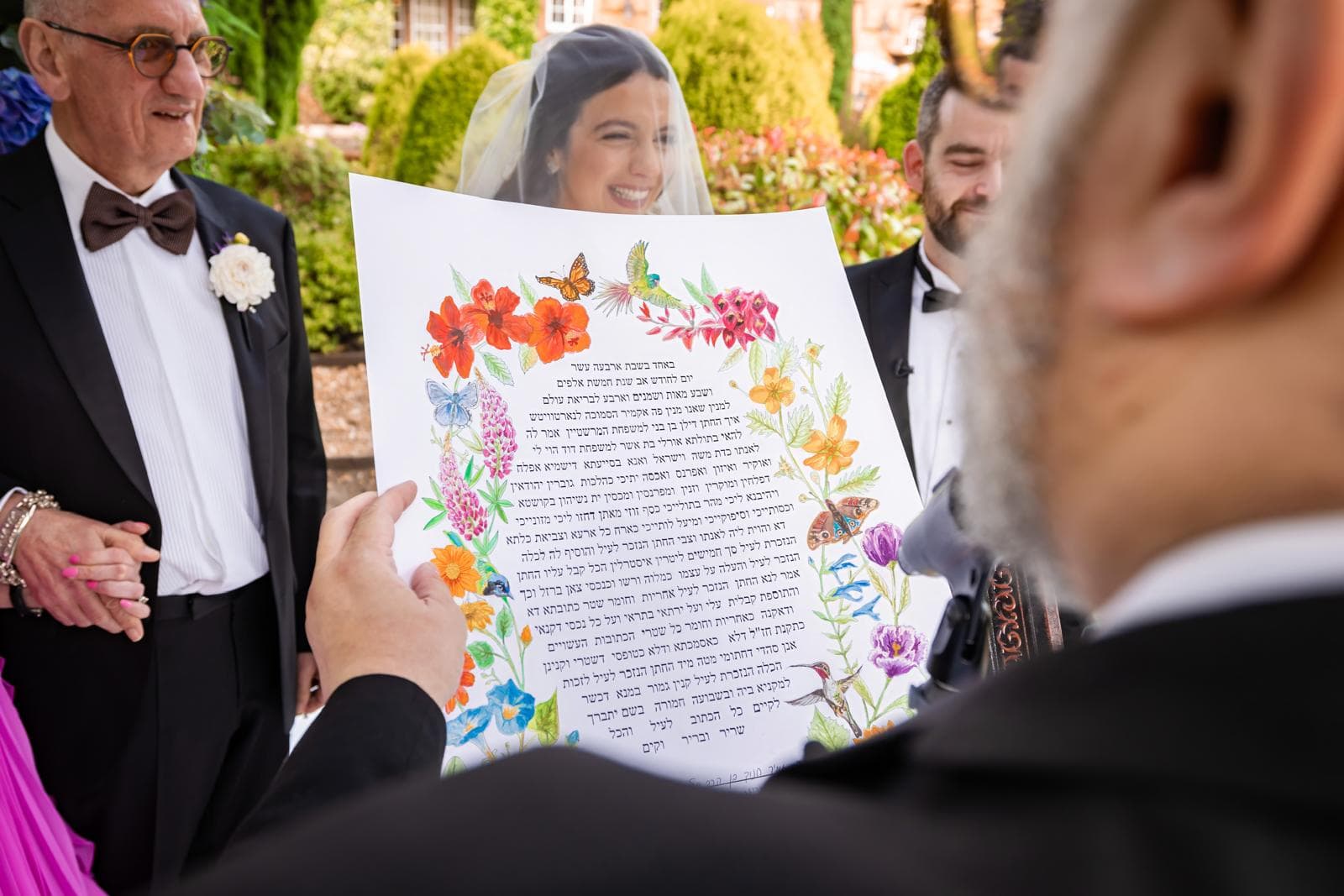
If you have seen a ketubah at a Jewish wedding, you probably remember the artwork first. It may have been floral, geometric, full of family symbols or completely contemporary. At its heart, though, a ketubah is a written commitment. It gives a Jewish marriage a document that can be read, signed, witnessed and kept.
That combination matters. A ketubah is at once a piece of Jewish legal history, a record of one particular wedding and, for many couples today, a statement of the home they hope to build together.
What does ketubah mean?
The word ketubah means “written document”. Its plural is ketubot. It is often translated as “Jewish marriage contract”, which is useful shorthand, although the exact role of the document depends on the text and the community using it.
In a traditional Jewish wedding, the ketubah is completed and signed before the chuppah, then read aloud before or during the ceremony. In most countries it does not replace a civil marriage certificate. It belongs to the Jewish ceremony and, when a traditional text is used, it can also function within halachah, the system of Jewish law.
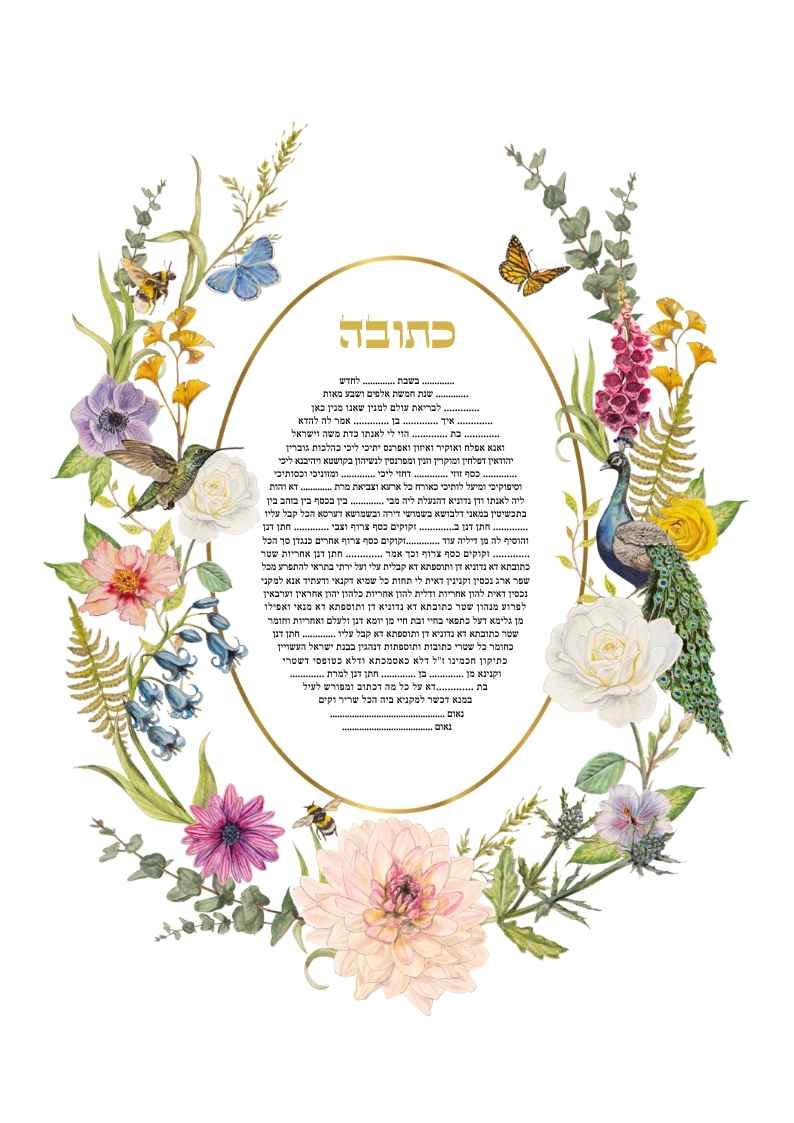
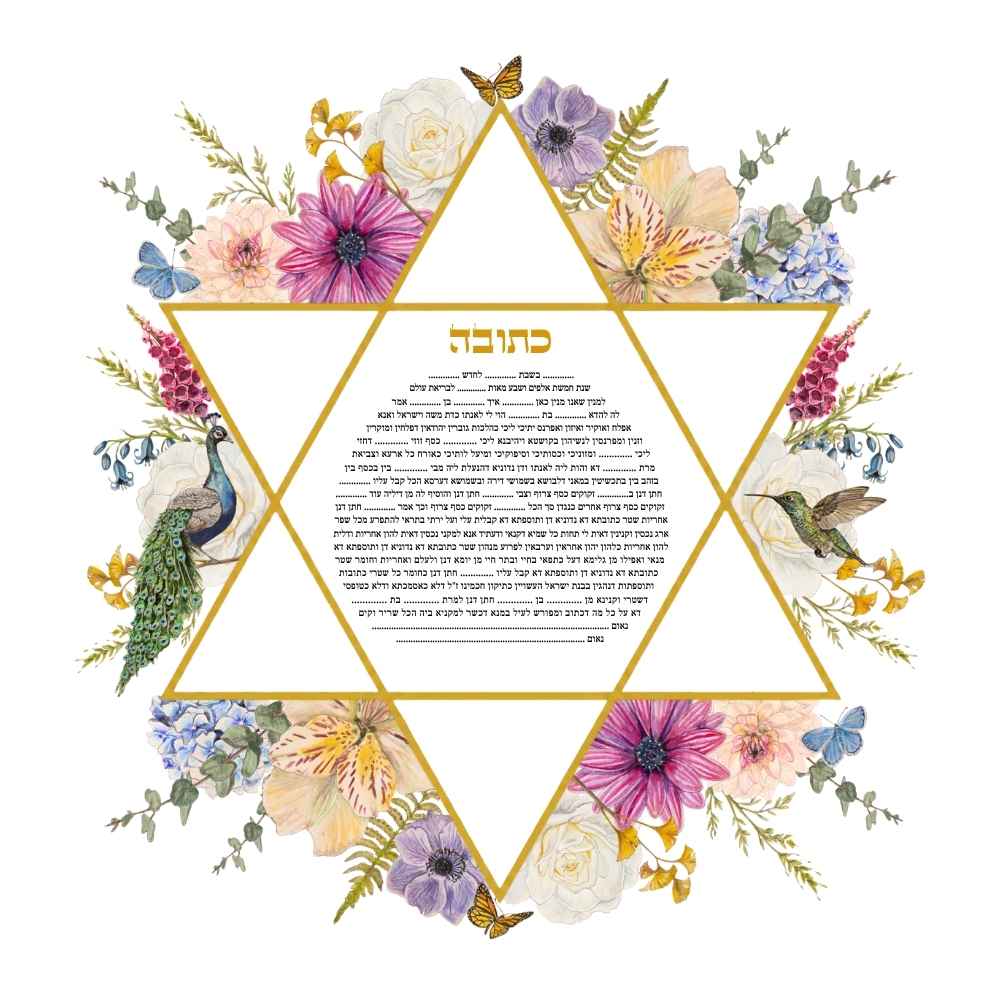
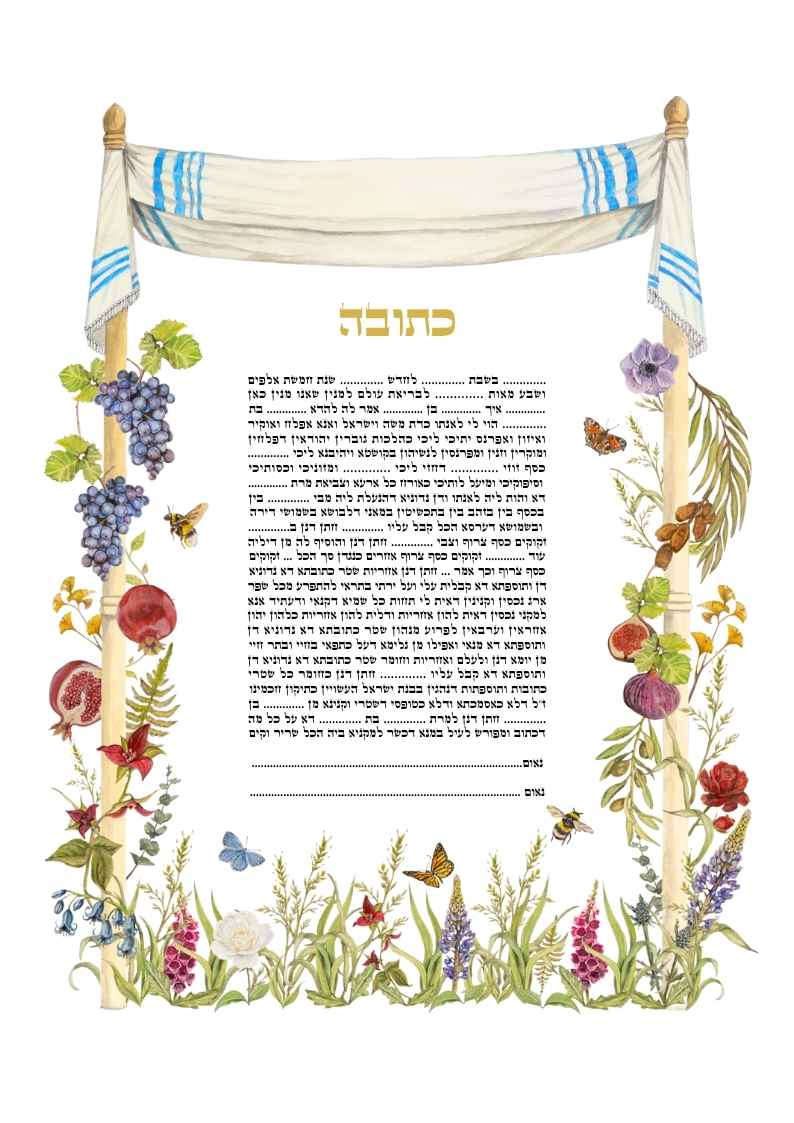
In a traditional ceremony, the ketubah belongs to the bride and is entrusted to her for safekeeping. Today, couples commonly frame it and display it at home. That is one reason ketubah art carries such weight. This is not a document designed to disappear into a drawer.
What does a ketubah contain?
A traditional ketubah is a legal document rather than a set of romantic vows. The familiar text is usually written in Aramaic, the everyday legal language used by Jewish communities in the rabbinic period. Its wording is formal because every name, date and obligation matters.
A traditional text generally includes the following elements:
- The people and the moment. It records the Hebrew names of the couple, the Hebrew date and the place of the wedding.
- The husband’s responsibilities. The groom accepts obligations to honour and support his wife, including food, clothing and marital intimacy.
- Financial protection. It states a settlement due to the wife if the marriage ends through divorce or the husband’s death, and may record a dowry and an additional sum.
- Witnessing. Witnesses sign to confirm that the commitments were formally accepted. The rules about who may witness vary by movement.
Contemporary ketubot can look quite different. Some retain the traditional Aramaic in full and add an English translation. Others use Hebrew and English to set out mutual promises about love, equality, family, Jewish life and care for one another. The artwork can be deeply personal in either case.
How do ketubah texts vary across Jewish communities?
There is no single modern ketubah text that suits every Jewish wedding. Labels are helpful, but individual rabbis and communities may follow different practices. Your officiant should always have the final say on whether a text meets the requirements of your ceremony.
Orthodox ketubahs
An Orthodox wedding normally uses the traditional Aramaic text with precise halachic wording. It describes the groom’s obligations to the bride and is typically signed by two witnesses who meet Orthodox requirements. Hebrew names, marital status, the date and the location must be recorded accurately. The artwork can feel entirely modern, but the legal wording should not be altered casually.
Conservative or Masorti ketubahs
Many Conservative and Masorti ceremonies begin with a traditional framework. Some use a ketubah containing the Lieberman clause, which refers disputes about religious divorce to the movement’s Jewish religious court, or bet din. The movement also has approved egalitarian approaches in which obligations are mutual. Practice differs between rabbis, so it is especially important to request the preferred text early.
Reform, Liberal and Reconstructionist ketubahs
These communities commonly treat the ketubah as an egalitarian covenant. Both partners make promises, and the wording may focus on the spiritual, ethical and practical life they intend to share. Texts are often bilingual and can be written for couples of any gender. Some couples use a recognised movement text, while others write something personal with their officiant.
Interfaith, secular and culturally Jewish ketubahs
Some couples choose a ketubah as a meaningful Jewish ritual even when their ceremony is interfaith or not governed by halachah. Their text may honour two traditions, describe shared values or make personal promises without legal language. The witness lines and wording can be adapted with the celebrant who is leading the ceremony.
How old is the ketubah tradition?
Jewish marriage documents reach back into antiquity. The framework most people recognise today took shape in the ancient rabbinic world and is discussed extensively in the Mishnah and Talmud. The Mishnah, compiled around the beginning of the third century CE, already treats the ketubah as an established part of marriage and records minimum financial settlements.
The use of Aramaic is a clue to that setting. Aramaic was widely spoken by Jewish communities and was a natural language for a practical legal document. As Jewish life spread across countries and centuries, local customs shaped the calligraphy, ornament and layout. Ketubot from Italy, North Africa, Persia and Eastern Europe can look strikingly different while serving a recognisable purpose.
This long history is why a ketubah can feel ancient and personal at the same time. Each couple joins an old practice, then gives it the visual language of their own place, family and moment.
Why was the ketubah important for women’s rights?
To understand the ketubah’s importance, we have to see it in the patriarchal world in which it developed. Women did not have equal social, financial or legal power. A husband could end a marriage, and the economic consequences for a wife could be severe.
The ketubah turned a husband’s responsibilities into a witnessed obligation. It required support during the marriage and created a financial claim if the marriage ended through divorce or his death. Rabbinic law also treated his property as security for the debt. In practical terms, divorce was no longer meant to be a cost-free decision that left a woman with nothing.
The Mishnah records a basic settlement of two hundred zuz, an ancient unit of currency, for a first-time bride and one hundred for a widow or divorcée, with the possibility of adding more. Those categories are uncomfortable to many modern readers, and rightly so. They reflect the assumptions of their time. What changed was that a wife now had a documented claim rather than relying only on goodwill or family negotiation.
It is important not to turn that achievement into a simple fairy tale of equality. The traditional ketubah is one-directional, it does not give husband and wife identical powers in divorce, and its financial terms do not automatically operate like a modern civil agreement. Its significance is more precise: within an unequal society, it created a durable legal protection for women and made marital responsibility public, specific and enforceable within the community.
Later Jewish movements have continued that work in different ways. Some preserve the traditional obligations and add protections concerning religious divorce. Others recast the whole document as a mutual covenant between equal partners. Both approaches begin with the same serious idea: marriage creates responsibilities, not only feelings.
What does a ketubah mean to couples today?
For many couples, the ketubah is the point where law, ritual, memory and art meet. It records a real date and place. It carries words said in front of witnesses. Then it comes home, where it can remain visible through ordinary days as well as anniversaries and celebrations.
That is why choosing one often feels different from choosing other wedding details. Flowers fade and place cards are packed away. A ketubah is made for the life that begins after the wedding. Whether your text is traditional, egalitarian or entirely personal, the best result feels truthful to your ceremony and unmistakably yours.