Ketubah design
Ketubah design ideas for meaningful wedding art
A practical guide to creating a ketubah that feels personal, keeps the text clear and becomes artwork you will want to live with after the wedding.
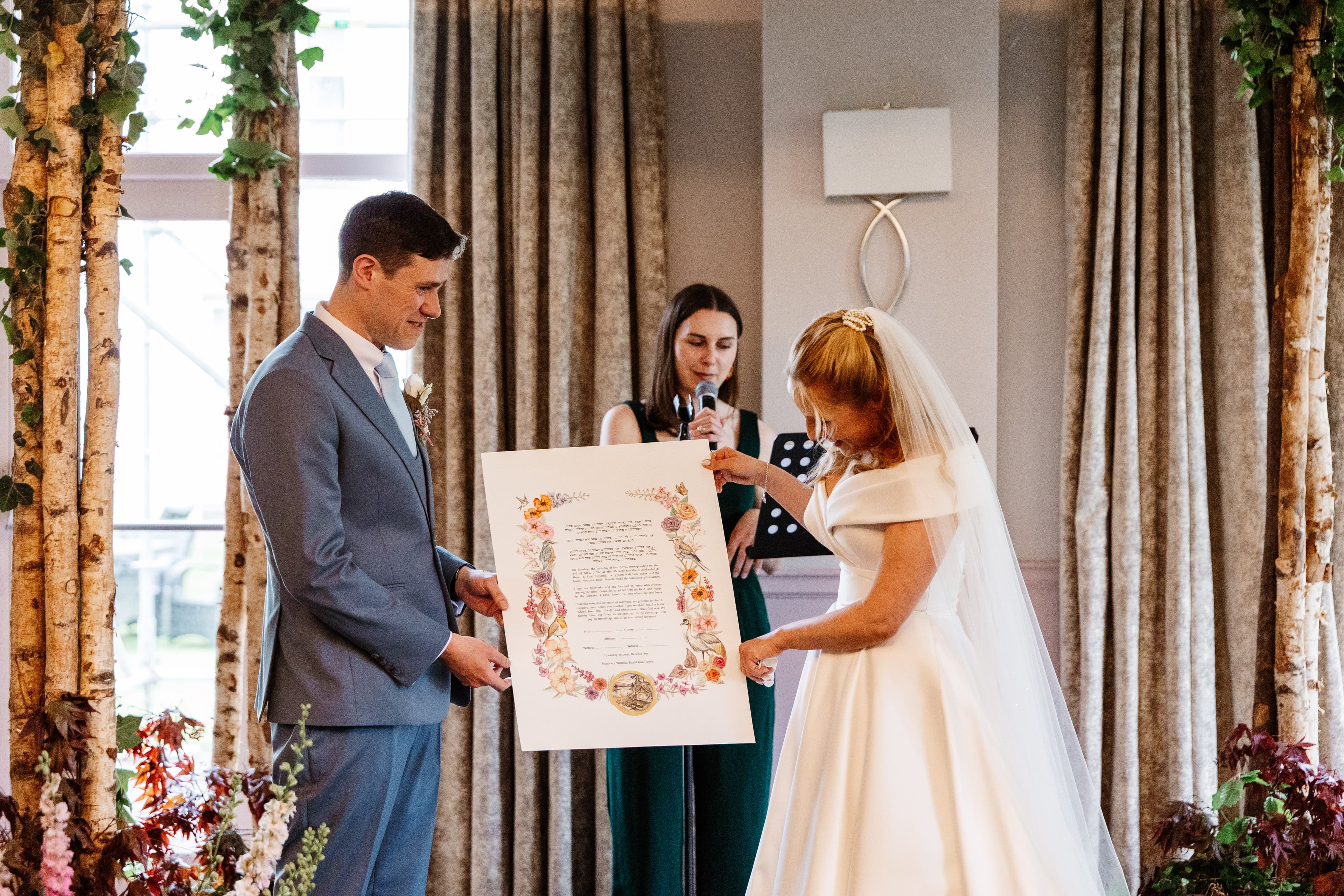
A ketubah design has two important jobs. It must give the words, names and signatures enough space to be read clearly, and it should turn the document into artwork that belongs to the couple. The most memorable designs do both without making either part feel secondary.
You do not need to begin with a finished visual concept. A place, flower, family tradition, colour or feeling can be enough. This guide will help you turn those first ideas into a useful design direction, whether you choose a personalised print or commission an entirely custom ketubah.
Begin with the feeling, not a list of motifs
It is tempting to begin by listing every symbol that could appear around the text. A stronger starting point is the atmosphere you want the finished piece to hold. It might feel joyful and abundant, calm and spacious, rooted in tradition, connected to a particular landscape or full of the colour of your wedding.
Think about the ketubah in three settings: during the ceremony, in photographs and on the wall at home. A design that works in all three will feel celebratory from a distance while still rewarding a closer look.
- Name the mood. Choose three or four words such as botanical, warm, luminous, geometric, playful or restrained.
- Picture its future home. Consider the room, wall colour and other artwork without feeling obliged to match the wedding decorations exactly.
- Choose what matters most. Identify one central story or visual idea before adding smaller details around it.
Explore ketubah styles and visual directions
Decorated ketubot have never belonged to one fixed visual style. Historical examples reflect the places and communities in which they were made, combining Jewish texts with local flowers, architecture, calligraphy, colour and decorative traditions. Contemporary couples can draw from that history without copying an antique design.
Floral and botanical
A border of wildflowers, garden plants or meaningful blooms can feel romantic and generous. The plants can come from the wedding season, a family garden or places connected to the couple.
Tree of life and landscape
Trees, branches and natural scenery can suggest roots, growth and a shared future. A real landscape can also anchor the artwork in the place where the couple met, married or made a home.
Geometric and heritage-inspired
Repeating forms, arches and ornamental borders can reference Moroccan, Persian, Italian or other family and artistic traditions. Specific heritage should be researched rather than reduced to a generic pattern.
Jerusalem and architectural
A skyline, doorway, window or remembered building can connect the ketubah to Jerusalem, a synagogue, a wedding venue or another meaningful place.
Contemporary and minimal
Open space, a limited palette and one carefully chosen motif can make a long bilingual text feel calm and clear. Minimal does not need to mean impersonal.
Narrative and highly personal
A custom composition can bring several parts of a story together, such as two landscapes, family plants, pets and symbols of a shared journey, while keeping one visual hierarchy.
Save references for their specific qualities rather than asking one design to imitate another. You might love the colour of one piece, the open layout of another and the natural movement of a third.
Choose Jewish symbols for their meaning
Jewish symbols can give a ketubah layers that remain meaningful long after the wedding. They work best when the couple understands why each one is present. There is no requirement to fill every corner, and a symbol that is important to one family may hold a different association for another.
- Chuppah. The wedding canopy can represent the home the couple will build and the welcome they hope to create within it.
- Tree of life. Roots, branches and new growth can speak to family, continuity, learning and a life that keeps developing.
- Seven species. Wheat, barley, grapes, figs, pomegranates, olives and dates connect the artwork with the produce used to praise the Land of Israel in Deuteronomy.
- Jerusalem. Images of the city have appeared in decorated ketubot for centuries, linking personal joy, Jewish memory and the hope of building a home.
- Magen David or hamsa. These familiar forms can create a strong centre or frame, but their scale and treatment should support the text rather than dominate it.
- Birds and animals. Paired birds, local wildlife or beloved pets can carry both historical symbolism and a very personal story.
Turn personal details into a coherent story
Personalisation can be quiet. A flower from a grandparent’s garden, the outline of a hill near the wedding venue or the colours of two different landscapes may carry more meaning than a literal timeline of the relationship.
For a custom ketubah, gather details under a few useful headings. Your artist can then find connections between them and decide what should lead, what should remain subtle and what may not belong in the final composition.
- Places. Where you met, grew up, became engaged, will marry or hope to build a home.
- Plants and seasons. Wedding flowers, birth-month plants, a family garden or species from meaningful landscapes.
- Family and heritage. Architectural forms, decorative traditions, heirlooms or symbols that genuinely connect with your families.
- Shared life. Pets, travel, music, nature, books or rituals that have a lasting place in your relationship.
- Colour memories. Colours tied to a place or feeling, not only the wedding stationery or table flowers.
How Jess and Olly’s travels became a ketubah
When I began working with Jess and Olly, they knew they wanted their ketubah to reflect their relationship, but they were not sure how to turn that feeling into an image.
Travel was an important part of their life together, although a collection of landmarks would not have felt personal enough. Through our conversations, the idea became a trail map. A winding route moves around the text, with each stop representing a place or memory from their life together.
At the foot of the design, I painted the couple looking towards the route ahead. The finished ketubah looks back at the experiences that shaped them while leaving the journey open for everything still to come. It became an artwork that could belong only to them.
Understand original art, personalised prints and downloads
“Hand-painted ketubah” can describe different things, so it is worth asking exactly what you will receive. An artist may paint the original artwork by hand and offer archival reproductions of that design, or may create a new original painting specifically for one couple.
The choice is also about how involved you want to be. Some couples prefer to select a finished composition and concentrate on the wording. Others want to shape the imagery with an artist or arrange each element themselves. The most personal route is the one that gives you the right kind of creative involvement, not automatically the most elaborate one.
Custom original
The composition is developed around your story and painted for your wedding. This offers the greatest creative freedom and normally needs the longest lead time and a larger budget.
Personalised fine-art print
You choose an existing design created from the artist’s original work. Your approved ketubah text and personal details are typeset into it before professional printing.
Downloadable file
You receive a digital file to print yourself or through a local printer. Check who is responsible for text accuracy, paper, colour, print scale and replacing the piece if something goes wrong.
Design it yourself online
Ketubah Studio lets you arrange Sophie’s individual hand-painted elements into a one-of-a-kind layout. You can create for free, then order a professionally finished ketubah or buy the digital artwork and arrange the text and printing yourself.
SHB offers personalised collection prints, the hands-on Ketubah Studio and fully custom commissions. Professionally finished orders include text preparation and a proof before printing. Ketubah Studio also offers an artwork-only download for couples who will arrange the wording and printing themselves.
Let the text shape the design
The artwork and wording should be planned together. A long bilingual text needs more quiet space than a short contemporary covenant. Signature lines also need comfortable room at the bottom, and decorative details should not make names or letters difficult to read.
Confirm the required wording with your rabbi or officiant before the final layout. Then review the actual proof for complete text, names, dates, place, signature labels and reading size. A beautiful border cannot rescue an incorrect or cramped document.
- Keep a clear text area. Contrast and open space should make the wording readable without fighting the illustration.
- Plan every language together. Hebrew, Aramaic and English may differ in length, direction and purpose, so they should not be squeezed into a layout as an afterthought.
- Protect the signatures. Leave enough room for the required number of people to sign comfortably with the pen approved for the paper.
- Review at printed scale. Zooming into a screen can make small type look more generous than it will on the finished ketubah.
Choose colour and scale for the wedding and the home
Wedding colours can start the conversation, but the ketubah will spend far longer in your home than at the venue. A palette can echo the celebration without matching every ribbon or flower. Look for colours you already enjoy living with and allow the artist to balance bright areas with quieter ones.
Scale affects both impact and readability. Mark the finished dimensions on a wall, then view them from across the room. Also plan how the ketubah will be transported and displayed at the ceremony. Choose one person to keep it safe, and ask your photographer for a clear image of the ketubah itself as well as the signing. Permanent conservation framing is usually safest after it has been signed.
SHB personalised prints are A2 portrait or 50 × 50 cm square, depending on the design, and are printed on archival 310gsm watercolour paper. The format leaves space for detailed artwork, clear text and signatures.
Create a short, useful ketubah design brief
A good brief gives an artist direction without trying to solve the composition in advance. Keep it short enough that the priorities remain visible. If two ideas conflict, decide which one matters more rather than asking the artwork to give everything equal weight.
- Overall feeling. Three or four words that describe the mood and visual character.
- Essential elements. The one to three symbols, places or personal details that must be present.
- Preferences and boundaries. Colours you love, colours you avoid and whether you prefer rich detail or open space.
- Text requirements. Languages, approved wording, number of signature lines and any instructions from the officiant.
- Practical details. Wedding date, final size, delivery country, budget and where the artwork may hang afterwards.