Ketubah planning
How to choose a ketubah
A practical, calm guide to the decisions that matter, from asking your officiant about the text to choosing artwork you will still love in your home years from now.
Choosing a ketubah should be one of the more meaningful parts of planning a Jewish wedding. It is also easy to feel unsure about where to begin. You are choosing important words for the ceremony, a piece of art for your home and a document in which names, dates and details must be exactly right.
The simplest way through is to make the decisions in the right order. Begin with the requirements of your ceremony, then choose the artwork and format, and leave enough time for careful proofing. This guide walks through each step and points out the questions couples most often discover too late.
Start with your rabbi or officiant
Before falling in love with a particular text, ask the person conducting your wedding what they require. A traditional Aramaic ketubah, a Masorti or Conservative text, an egalitarian covenant and an interfaith text do not serve exactly the same ceremonial purpose. Individual rabbis and communities can also have requirements that are more specific than a movement label suggests.
Ask whether they will supply the complete wording or expect you to choose it. Confirm which languages should appear, how your names and the wedding location should be written, how many signature lines are needed and who may sign. If your ceremony is taking place under United Synagogue auspices in the UK, for example, the ketubah must use an approved form and the rabbi must be satisfied that it is accurate.
This conversation does not need to settle the visual design. It simply establishes the non-negotiable parts of the document before the artwork is typeset around them.
Choose wording that belongs in your ceremony
The artwork may be the first thing guests notice, but the words are the centre of the ketubah. Read the complete text together rather than choosing from a category name alone. Ask yourselves whether it accurately describes your ceremony, your commitments and the Jewish life you intend to build.
Some couples use a fixed legal text and add an English translation. Others choose mutual promises in Hebrew and English, or write personal wording with their officiant. None of these decisions should be made by altering a traditional text casually. If the document is intended to meet halachic requirements, use the exact version approved for your wedding.
Traditional or Orthodox
Expect precise Aramaic wording, personal details completed according to halachic rules and witnesses approved by the officiating rabbi.
Masorti or Conservative
Ask which authorised text is used by your community and whether it includes the Lieberman clause or another approved egalitarian approach.
Reform, Liberal or egalitarian
Look for mutual language that reflects your values, then confirm the wording and witness requirements with your rabbi or cantor.
Interfaith, secular or personal
Decide how Jewish tradition, two family backgrounds and your own promises should be represented, with guidance from the person leading the ceremony.
Do not assume that the English is a literal translation of the Hebrew or Aramaic. In many contemporary ketubot, the two parts play different roles. Read both with someone qualified to check them.
Decide between a personalised print and custom artwork
A personalised ketubah print begins with existing artwork. Your approved text, names and wedding details are carefully typeset into the design, and you receive a proof before it is printed. This is a good choice when you already love the artwork and want a clear price and a shorter creative process.
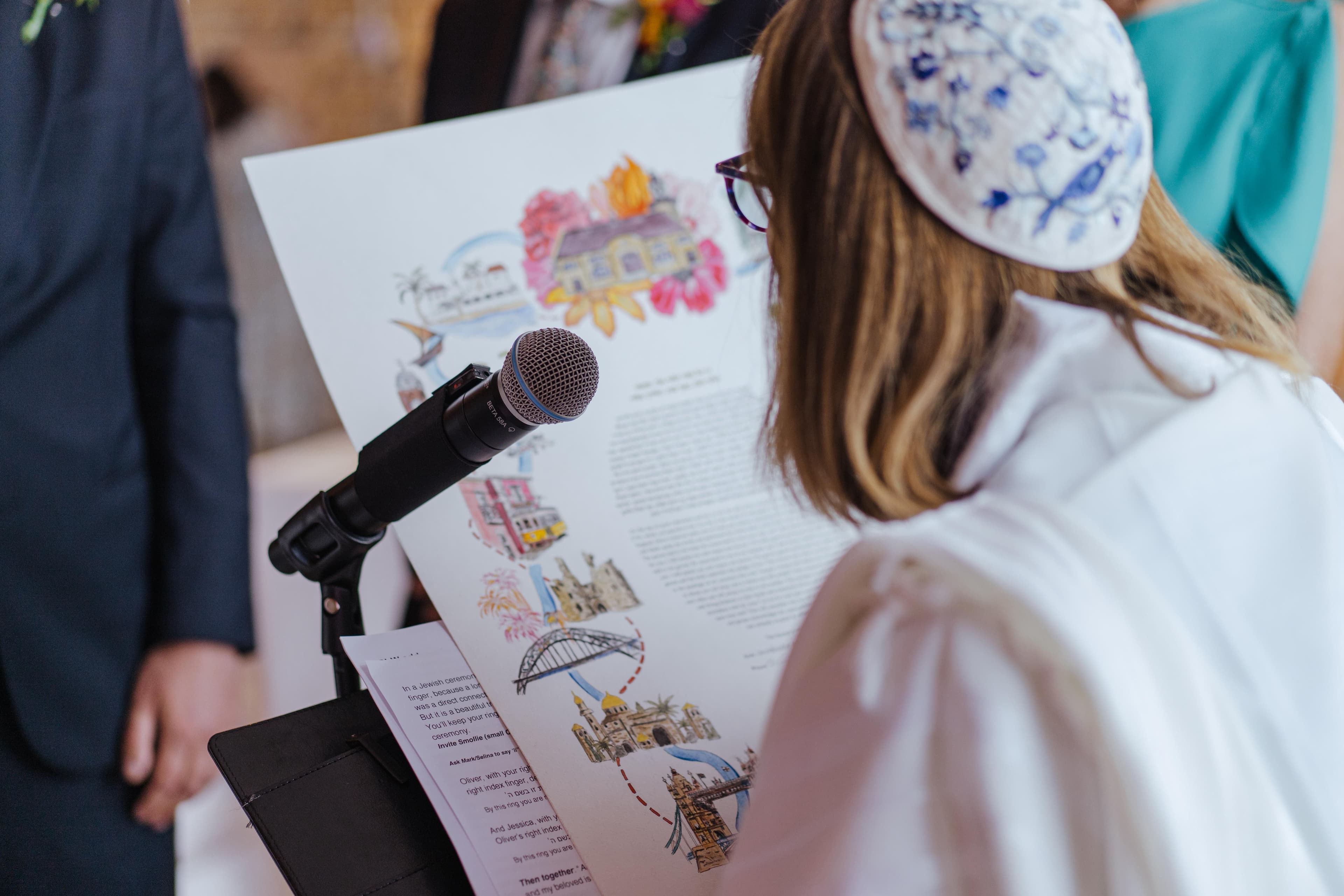
A custom ketubah begins with your story. The imagery might include a wedding location, meaningful landscapes, family flowers, pets, travels, architecture or Jewish symbols that carry particular meaning for you. The result is entirely individual, but the process needs more conversation, design time and budget.
Choose a personalised print if…
You love an existing design, want the text made personal to you and prefer a direct route from order to proof and printing.
Choose a custom ketubah if…
You want the art to tell your story, need an unusual format or have a particular visual idea that cannot be found in an existing collection.
Choose art for the home you are building
Your wedding colours can be a useful starting point, but they do not have to control the decision. The ketubah will spend far longer on a wall than it will at the venue. Imagine it in your home on an ordinary Tuesday, not only beside the flowers and table settings on the wedding day.
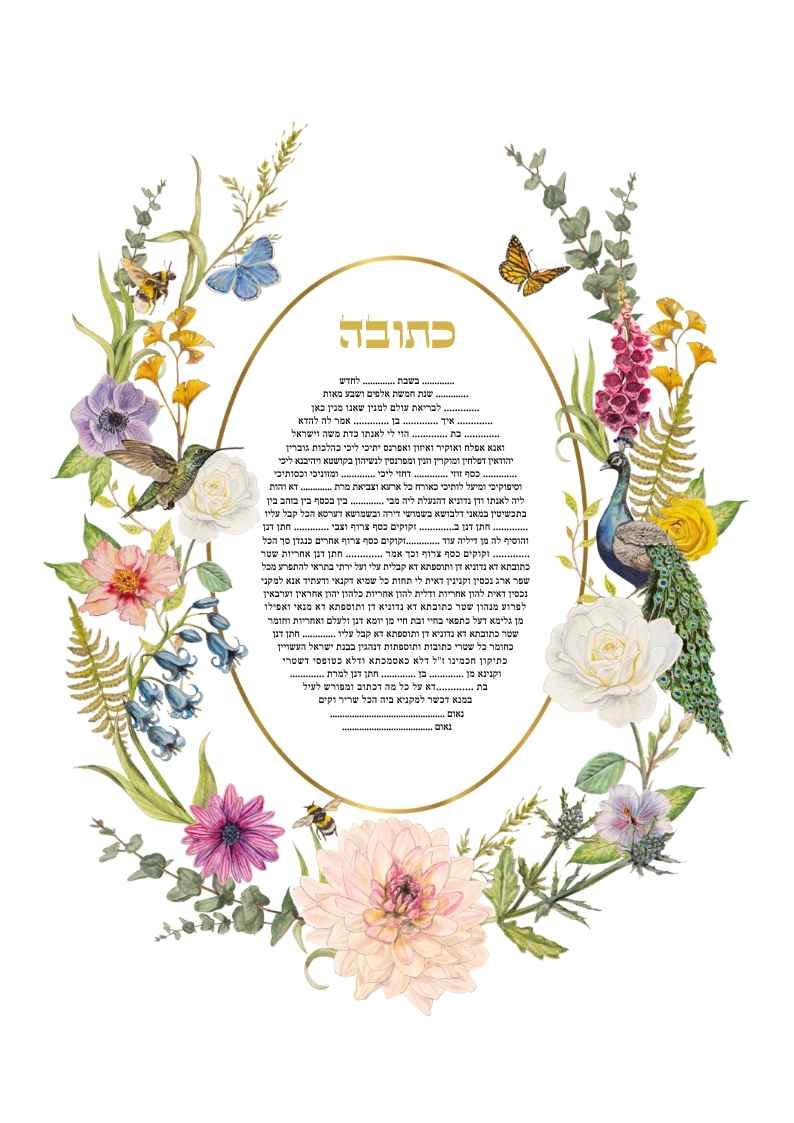
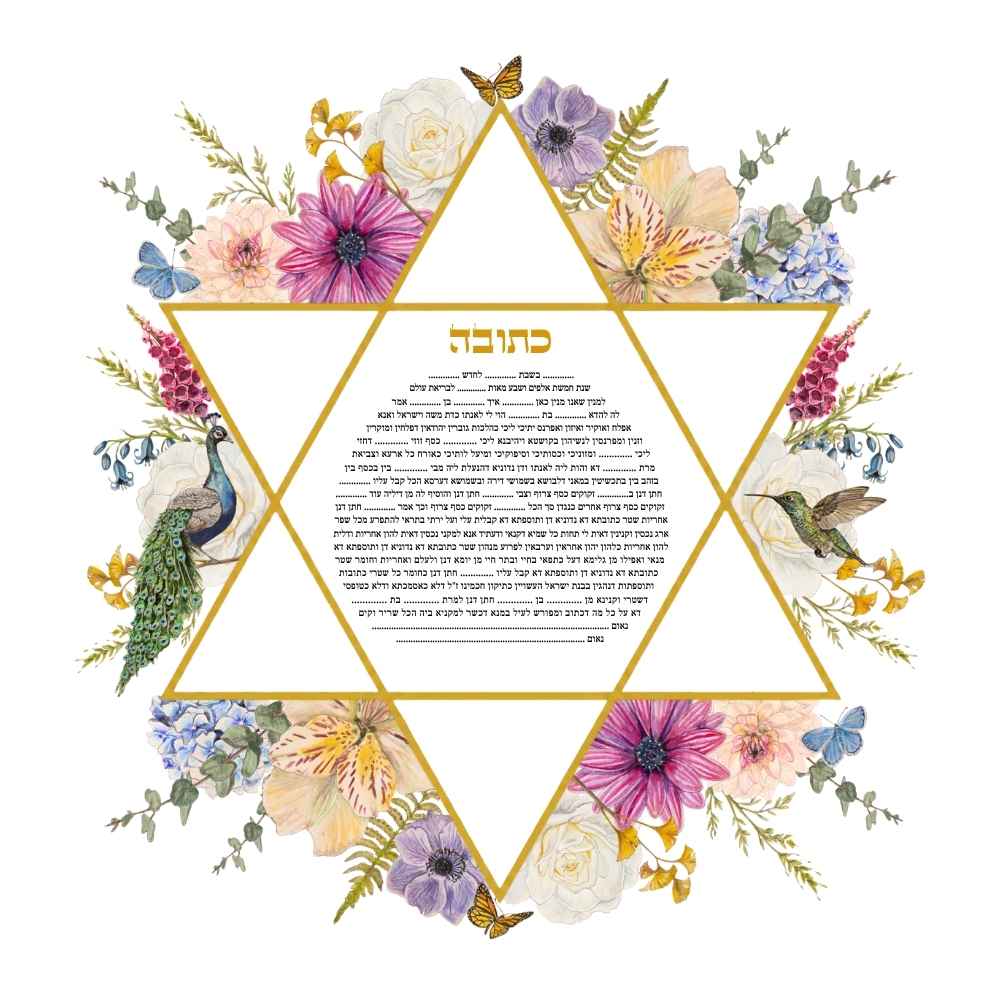
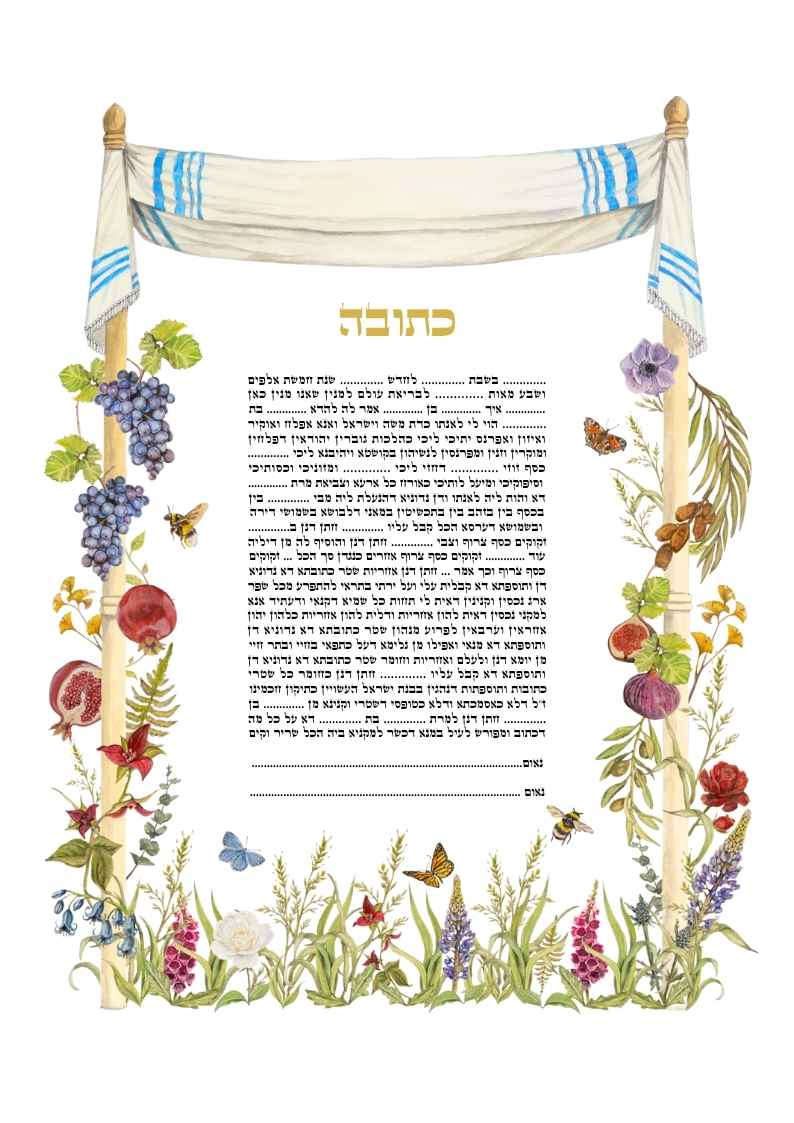
Look for imagery that has staying power for you. It might be a chuppah, a Tree of Life, the Seven Species, a Magen David or hamsa. It might simply be a garden full of colours and creatures you both love. A symbol is most meaningful when you understand why you want to live with it.
Also notice the balance between the image and the text. Dense bilingual wording needs generous clear space and a design that keeps the letters readable. A shorter contemporary covenant can sit comfortably within a more intricate composition.
- Picture the future room. Think about wall size, surrounding colours and whether you prefer a quiet focal point or an abundant one.
- Name the personal connection. Choose symbols, flowers, places or animals because they mean something to you, not because they seem compulsory.
- Protect readability. Make sure the text remains visually central and can be read comfortably at its finished size.
See these symbols in the collection
Check the size, shape and paper
Online measurements are difficult to picture. Mark the proposed dimensions on a wall with low-tack tape, or place sheets of paper together on the floor. Then step back. This makes the difference between a modest print and a substantial piece of art much easier to understand.
SHB ketubah prints are either A2 portrait, which is 42 × 59.4 cm, or 50 × 50 cm square, depending on the design. Each is printed on archival 310gsm watercolour paper. The generous scale gives the artwork presence while leaving room for readable text and signatures.
Before ordering a frame, check the final paper dimensions and ask whether the artwork should be floated or mounted. Do not let a mount cover signature lines or details near the edge. Because the ketubah must still be signed, it is usually safest to arrange permanent framing after the ceremony.
Work backwards from the wedding date
The delivery estimate is only the final part of the timeline. Before printing, you need the correct text, complete personal details, typesetting, a proof, time for you and your officiant to review it, and time for any corrections. Custom artwork also needs a design and painting period.
For SHB personalised prints, current guidance is dispatch within about one week after the final proof is approved. Custom commissions typically take around eight weeks from the start of the project to dispatch. International shipping can add about one additional week to the process, with delivery usually taking an extra 5 to 7 days. These are working estimates, so confirm availability for your date and leave a calm buffer for approval and transit.
The safest approach is to contact the artist as soon as you know the wedding date and the type of ketubah your ceremony requires. You do not need every Hebrew spelling finalised before beginning a conversation, but you should not leave the officiant’s approval until the parcel is ready to ship.
Treat the proof as part of the ceremony
A proof is not just a preview of the colours. It is your opportunity to check every piece of information before ink reaches paper. Review it once for the meaning of the text, once for personal details and once for the visual layout. Ask your officiant to review the actual final proof, not an earlier document from which the wording was copied.
- Names. Check English names, Hebrew names, parents’ names, titles, spelling and any relevant status carefully.
- Date. Confirm both the civil and Hebrew dates where applicable, especially if the ceremony begins after sunset.
- Place. Check the required form of the town or city and any traditional geographical details requested by the officiant.
- Complete wording. Compare every paragraph with the approved source text rather than relying on memory.
- Signature lines. Confirm who signs, how many lines are required and whether labels need to appear in Hebrew or English.
- Layout. Read the proof at a realistic printed scale and flag text that feels crowded, small or too close to the artwork.
Both partners should check the proof independently. Fresh eyes catch different mistakes. Approval should feel deliberate, not like one more box hurriedly ticked during the final week before the wedding.
Plan for signing, transport and life at home
Ask your officiant when the ketubah will be completed, who will sign it and which pen should be used. Requirements differ between communities, so do not pre-sign it or test a pen on the artwork. If possible, test the chosen pen on a separate sample of the same paper.
Keep the ketubah flat, clean and protected while it travels. At the venue, place it away from drinks, food, candles, damp flowers and busy walkways. Choose a stable signing surface and ask one trusted person to be responsible for moving it safely after the ceremony.
For display at home, use a professional framer who understands works on paper. Ask for conservation-quality, acid-free materials, make sure the artwork does not touch the glazing and avoid direct sunlight, radiators, vents and damp rooms. Good framing protects both the document and the memory it carries.